

Tạo bản chép lời YouTube từ mọi video miễn phí
Tạo bản chép lời YouTube từ mọi video miễn phí
Nhận ngay bản chép lời và
bản tóm tắt cho video YouTube
Transcript
Summary
EN
Bản chép lời có mốc thời gian
There are only two kinds of people who do not experience painful emotions. The first kind are the psychopaths. The second kind are dead. There is a false understanding or expectation that a happy life means being happy all the time. No. Learning to accept, and even embrace painful emotions is an important part of a happy life.
00:00
And the study of painful emotions is an important part of the field of happiness studies. My name is Tal Ben Shahar. I'm a student and teacher in the field of happiness studies. And my most recent book is "Happier, No Matter What". There is a very important concept that was introduced by Nassim Taleb. And that is antifragility.
00:27



Khai phá sức mạnh
của Scripsy AI
Khai phá sức mạnh
của Scripsy AI


Chép lời video YouTube chỉ với một cú nhấp
Chép lời video YouTube chỉ với một cú nhấp
Chuyển mọi video thành văn bản với mốc thời gian chính xác. Miễn phí. Mãi mãi.
Chuyển mọi video thành văn bản với mốc thời gian chính xác. Miễn phí. Mãi mãi.
Transcript
Summary
EN
00:00
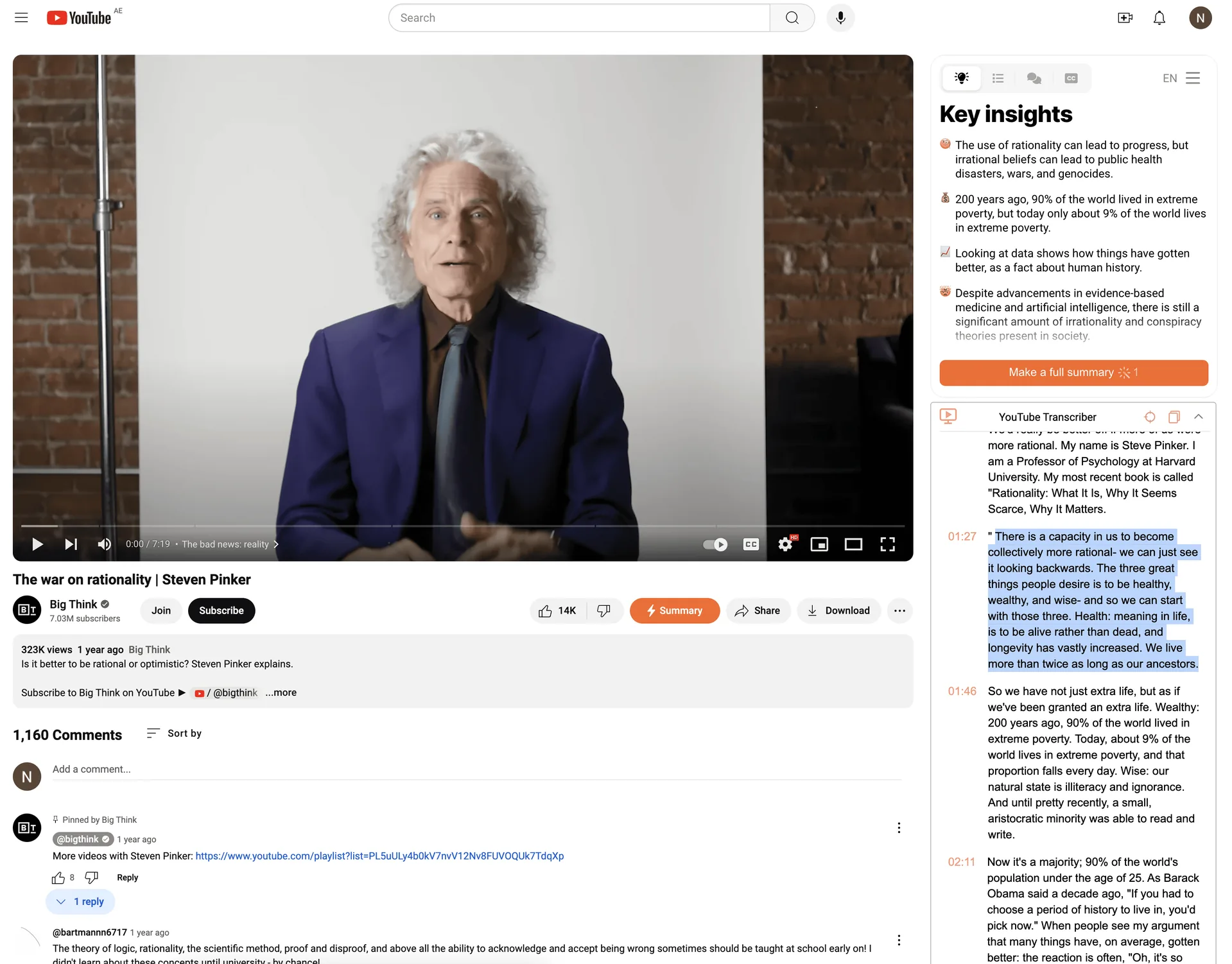
A question that I often get is: Do you believe in progress? Well, I don't believe in progress, at least not as a force in the Universe. To quote Fran Lebowitz, "I don't believe in anything you have to believe in." Because there isn't any arc bending toward justice. There is no force that's lifting us ever upward.
00:18
Quite the contrary. The Universe often seems to be out to get us. There are parasites that want to eat us from the inside. There's the laws of entropy: there are more ways for things to go wrong than to go right. There's human nature: we were not selected by the processes of evolution to be particularly nice.
00:36
We have the capacity for revenge and exploitation. So that's what's lined up against us. But nonetheless, progress has happened. How do we explain that? What might seem like a miracle? The answer is 'rationality.' If people deploy their rationality, their cognition, their language_with the goal of making other people better off- then the result, over time, is what we call 'progress.
00:59
Can we become more rational? It's a pressing question because irrational beliefs lead to public health disasters. They can lead to wars and genocides. We'd really be better off if more of us were more rational. My name is Steve Pinker. I am a Professor of Psychology at Harvard University. My most recent book is called "Rationality: What It Is, Why It Seems Scarce, Why It Matters.
01:27
There is a capacity in us to become collectively more rational — we can just see it looking backwards. The three great things people desire is to be healthy, wealthy, and wise- and so we can start with those three. Health: meaning in life, is to be alive rather than dead, and longevity has vastly increased. We live more than twice as long as our ancestors.
01:46
So we have not just extra life, but as if we've been granted an extra life. Wealthy: 200 years ago, 90% of the world lived in extreme poverty. Today, about 9% of the world lives in extreme poverty, and that proportion falls every day. Wise: our natural state is illiteracy and ignorance. And until pretty recently, a small, aristocratic minority was able to read and write.

Transcript
Summary
EN
00:00
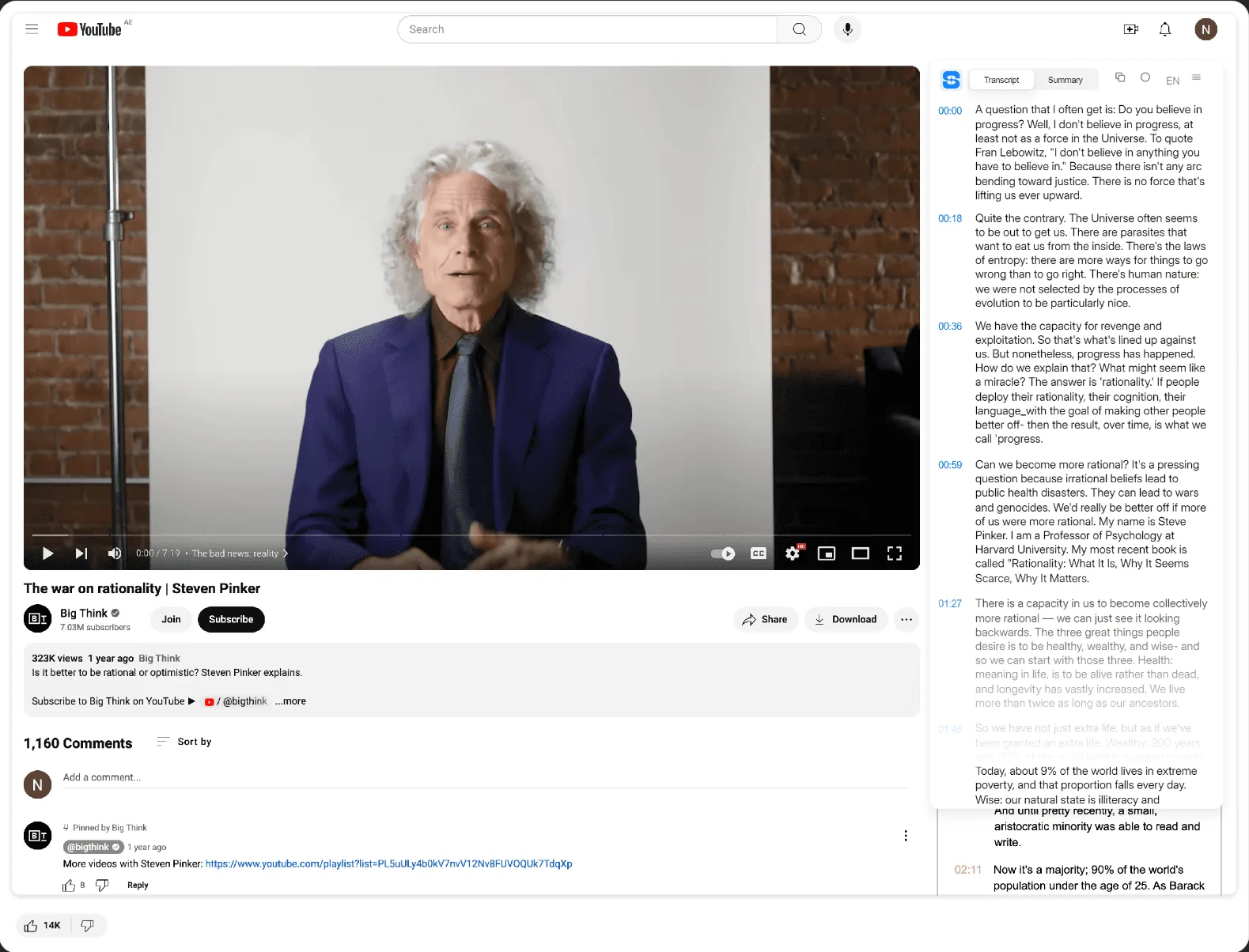
A question that I often get is: Do you believe in progress? Well, I don't believe in progress, at least not as a force in the Universe. To quote Fran Lebowitz, "I don't believe in anything you have to believe in." Because there isn't any arc bending toward justice. There is no force that's lifting us ever upward.
00:18
Quite the contrary. The Universe often seems to be out to get us. There are parasites that want to eat us from the inside. There's the laws of entropy: there are more ways for things to go wrong than to go right. There's human nature: we were not selected by the processes of evolution to be particularly nice.
00:36
We have the capacity for revenge and exploitation. So that's what's lined up against us. But nonetheless, progress has happened. How do we explain that? What might seem like a miracle? The answer is 'rationality.' If people deploy their rationality, their cognition, their language_with the goal of making other people better off- then the result, over time, is what we call 'progress.
00:59
Can we become more rational? It's a pressing question because irrational beliefs lead to public health disasters. They can lead to wars and genocides. We'd really be better off if more of us were more rational. My name is Steve Pinker. I am a Professor of Psychology at Harvard University. My most recent book is called "Rationality: What It Is, Why It Seems Scarce, Why It Matters.
01:27
There is a capacity in us to become collectively more rational — we can just see it looking backwards. The three great things people desire is to be healthy, wealthy, and wise- and so we can start with those three. Health: meaning in life, is to be alive rather than dead, and longevity has vastly increased. We live more than twice as long as our ancestors.
01:46
So we have not just extra life, but as if we've been granted an extra life. Wealthy: 200 years ago, 90% of the world lived in extreme poverty. Today, about 9% of the world lives in extreme poverty, and that proportion falls every day. Wise: our natural state is illiteracy and ignorance. And until pretty recently, a small, aristocratic minority was able to read and write.

Tóm tắt video bằng AI
Tóm tắt video bằng AI
Tóm tắt video chỉ trong vài giây, ngắn gọn và súc tích nhờ AI
Tóm tắt video chỉ trong vài giây, ngắn gọn và súc tích nhờ AI
Transcript
Summary
EN
Unlocking Progress: How Rationality Drives Human Advancemen
Exploring the Power of Rational Thinking in Overcoming Universal and Human Challenges
Exploring the Concept of Progress
in the Universe
A question that I often get is: Do you believe in progress? Well, I don’t believe in progress, at least not as a force in the Universe. To quote Fran Lebowitz, “I don’t believe in anything you have to believe in.” Because there isn’t any arc bending toward justice. There is no force that’s lifting us ever upward.
Challenges from Natural and Human Forces
Quite the contrary. The Universe often seems to be out to get us. There are parasites that want to eat us from the inside. There’s the laws of entropy: there are more ways for things to go wrong than to go right. There’s human nature: we were not selected by the processes of evolution to be particularly nice. We have the capacity for revenge and exploitation. So that’s what’s lined up against us.
How Rationality Explains Human Advancement
But nonetheless, progress has happened. How do we explain that? What might seem like a miracle? The answer is ‘rationality.’ If people deploy their rationality, their cognition, their language with the goal of making other people better off, then the result, over time, is what we call ‘progress.’
Post-Match Thoughts
• Reflections on the outcome and what it means for both teams moving forward.
• Speculation on how Team Liquid will fare against Gladiators in the grand final.
• Insights into the overall strategies and adjustments that may be needed for future matches.
Player and Team Dynamics
• Discussion on the mentality and preparation of players, including anecdotes about personal experiences and team dynamics.
• Mention of the importance of hygiene and professionalism in a team environment.
• Insights into how different players handle pressure and contribute to their team’s success.
Transcript
Summary
EN
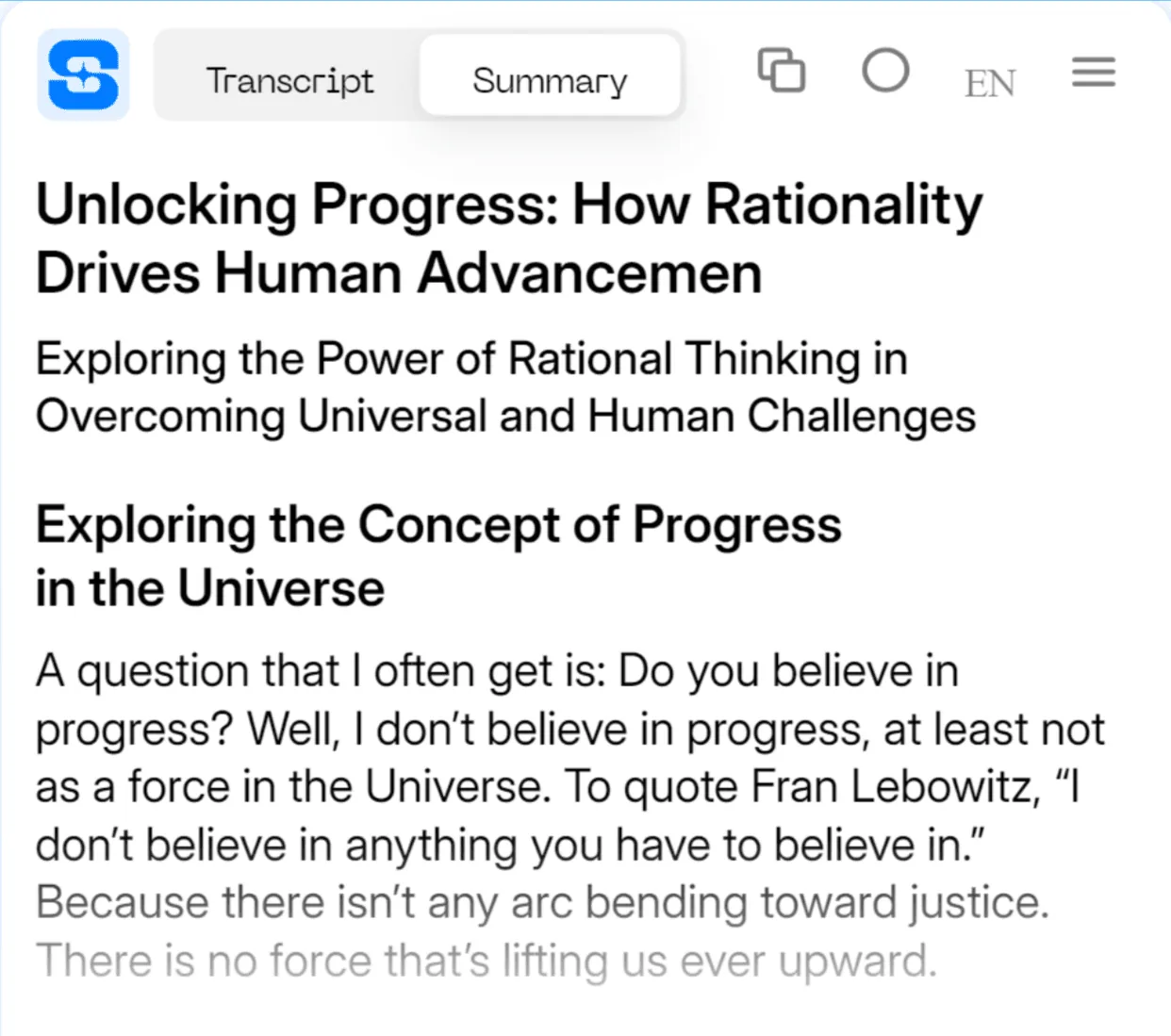
Unlocking Progress: How Rationality Drives Human Advancemen
Exploring the Power of Rational Thinking in Overcoming Universal and Human Challenges
Exploring the Concept of Progress
in the Universe
A question that I often get is: Do you believe in progress? Well, I don’t believe in progress, at least not as a force in the Universe. To quote Fran Lebowitz, “I don’t believe in anything you have to believe in.” Because there isn’t any arc bending toward justice. There is no force that’s lifting us ever upward.
Challenges from Natural and Human Forces
Quite the contrary. The Universe often seems to be out to get us. There are parasites that want to eat us from the inside. There’s the laws of entropy: there are more ways for things to go wrong than to go right. There’s human nature: we were not selected by the processes of evolution to be particularly nice. We have the capacity for revenge and exploitation. So that’s what’s lined up against us.
How Rationality Explains Human Advancement
But nonetheless, progress has happened. How do we explain that? What might seem like a miracle? The answer is ‘rationality.’ If people deploy their rationality, their cognition, their language with the goal of making other people better off, then the result, over time, is what we call ‘progress.’
Post-Match Thoughts
• Reflections on the outcome and what it means for both teams moving forward.
• Speculation on how Team Liquid will fare against Gladiators in the grand final.
• Insights into the overall strategies and adjustments that may be needed for future matches.
Player and Team Dynamics
• Discussion on the mentality and preparation of players, including anecdotes about personal experiences and team dynamics.
• Mention of the importance of hygiene and professionalism in a team environment.
• Insights into how different players handle pressure and contribute to their team’s success.

Nắm ý chính thật nhanh
Nắm ý chính thật nhanh
Chia nhỏ ý chính thành
các đoạn văn mạch lạc
Chia nhỏ ý chính thành
các đoạn văn mạch lạc
Transcript
Summary
new
EN
Key Ideas Breakdown
Belief in Progress
Steven Pinker addresses the question of whether he believes in progress. He cites Fran Lebowitz, expressing skepticism about progress as an inherent force in the Universe. Pinker argues that there is no natural arc bending towards justice or improvement, and he emphasizes that progress is not guaranteed.
Challenges from the Universe
Pinker describes various adversities that seem to challenge human existence. He mentions natural threats such as parasites that can harm us internally and the laws of entropy, which suggest that there are more ways for things to go wrong than right. Additionally, he points out that human nature, shaped by evolution, includes tendencies towards revenge and exploitation.


Dễ cài đặt
Dễ cài đặt
Tiện ích Chrome đơn giản, cài đặt và sử dụng nhanh chóng
Tiện ích Chrome đơn giản, cài đặt và sử dụng nhanh chóng
Dịch sang 50+ ngôn ngữ
Dịch sang 50+ ngôn ngữ
Dịch miễn phí bản chép lời và bản tóm tắt sang mọi ngôn ngữ
Dịch miễn phí bản chép lời và bản tóm tắt sang mọi ngôn ngữ
🇬🇧 English
🇨🇳 Mandarin Chinese
🇪🇸 Spanish
🇪🇸 Spanish
🇮🇳 Hindi
🇵🇹 Portuguese
🇯🇵 Japanese
🇫🇷 French
🇩🇪 German
🇰🇷 Korean
🇰🇷 Korean
🇺🇦 Ukrainian
🇹🇷 Turkish
🇨🇳 Mandarin Chinese
🇨🇳 Mandarin Chinese
Cài tiện ích Chrome
Người dùng nói gì
về chúng tôi
Người dùng nói gì
về chúng tôi

Scripsy đã thay đổi hoàn toàn cách mình xem nội dung trên YouTube. Tính năng chép lời và tóm tắt giúp mình tiết kiệm biết bao thời gian!

John Davis
Cảm ơn vì tiện ích này! Giao diện đẹp, dễ dùng, dễ cài đặt. Thứ không thể thiếu cho ai dùng YouTube để làm việc hoặc học tập.

Sophie W.
Tiện ích đỉnh nhất trong các tiện ích cùng loại cho đến giờ!!! Cảm ơn nhiều lắm, cứ tiếp tục phát huy nhé💪🏻🔥

Bogdan Peregubko
Xem thêm đánh giá
Câu hỏi thường gặp
Câu hỏi thường gặp
Scripsy là gì?
Làm thế nào để cài tiện ích Chrome Scripsy AI để chép lời YouTube?
Có bản dùng thử miễn phí không?
Với gói miễn phí, tôi có thể tạo bao nhiêu bản tóm tắt?
Tôi có thể dịch bản chép lời và bản tóm tắt YouTube sang nhiều ngôn ngữ không?
Tôi có thể chép lời những video nào?
Tôi có thể dùng Scripsy trên trình duyệt khác không?
Mất bao lâu để tạo bản chép lời?
Theo dõi chúng tôi 🫦


