

สรุปวิดีโอ YouTube ด้วย AI
สรุปวิดีโอ YouTube ด้วย AI
ถอดเสียงและสรุปวิดีโอ YouTube
& พอดแคสต์ได้ในไม่กี่วินาที ลองใช้ฟรี!
Transcript
Summary
EN
Short Description:
Tal Ben-Shahar explains that true happiness isn’t about avoiding pain but embracing challenges to grow stronger — a concept called antifragility. Instead of directly chasing happiness, which can backfire, we should focus on five key areas: spiritual purpose, physical recovery, intellectual curiosity, strong relationships, and emotional resilience. By cultivating these, we indirectly increase happiness and learn to make the best of life's hardships.
Timestamped Summary:
00:00 - 00:26 – Happiness Misconception: Painful emotions are unavoidable; only psychopaths or the dead feel no pain. Happiness doesn’t mean constant



ปลดล็อกพลัง
ของ Scripsy AI
ปลดล็อกพลัง
ของ Scripsy AI


ถอดเสียงวิดีโอ YouTube ฟรี
ถอดเสียงวิดีโอ YouTube ฟรี
ถอดเสียงวิดีโอไหนก็ได้เป็นข้อความ พร้อมไทม์สแตมป์แม่นยำ ฟรี ตลอดไป
ถอดเสียงวิดีโอไหนก็ได้เป็นข้อความ พร้อมไทม์สแตมป์แม่นยำ ฟรี ตลอดไป
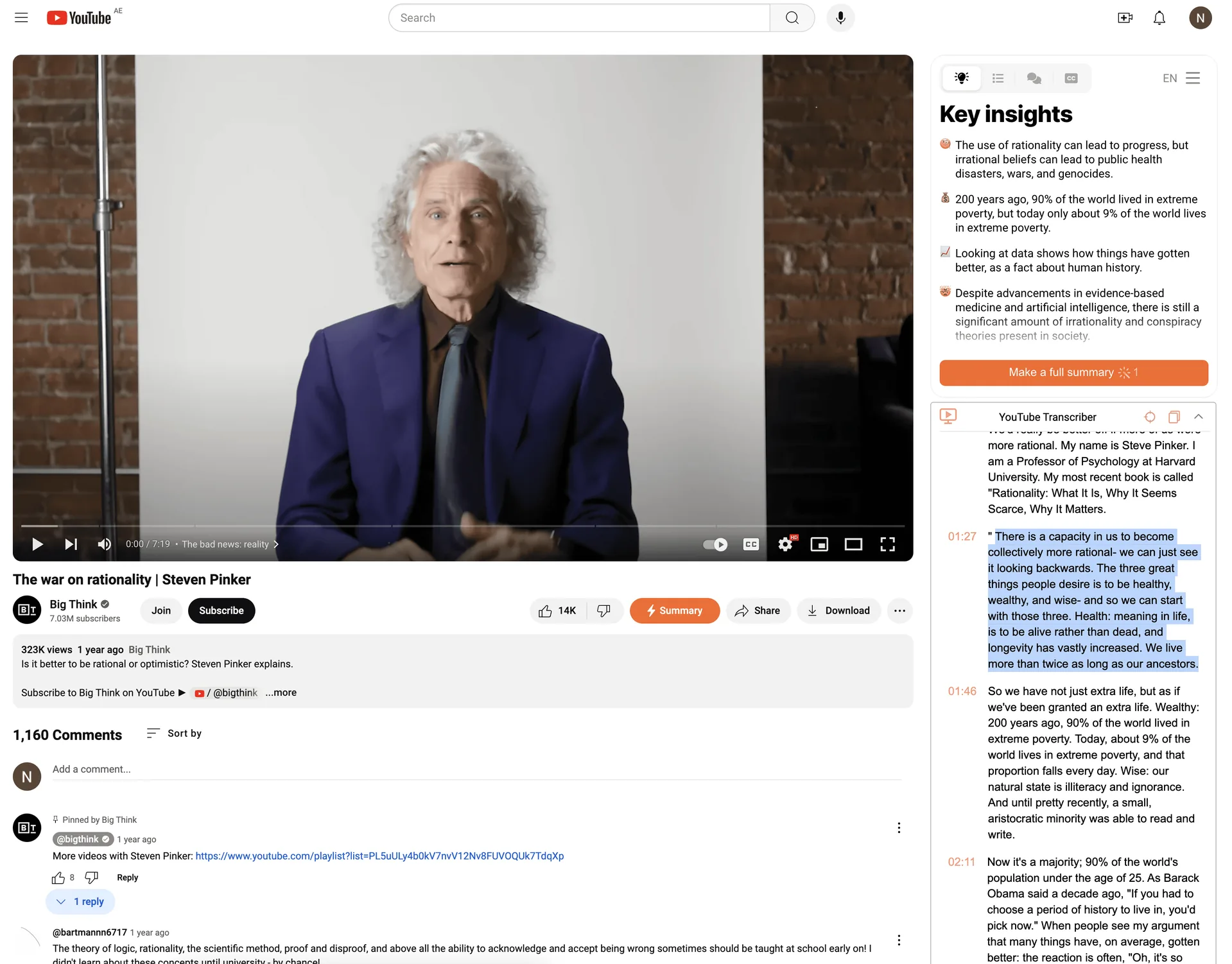
Transcript
Summary
EN
00:00
A question that I often get is: Do you believe in progress? Well, I don't believe in progress, at least not as a force in the Universe. To quote Fran Lebowitz, "I don't believe in anything you have to believe in." Because there isn't any arc bending toward justice. There is no force that's lifting us ever upward.
00:18
Quite the contrary. The Universe often seems to be out to get us. There are parasites that want to eat us from the inside. There's the laws of entropy: there are more ways for things to go wrong than to go right. There's human nature: we were not selected by the processes of evolution to be particularly nice.
00:36
We have the capacity for revenge and exploitation. So that's what's lined up against us. But nonetheless, progress has happened. How do we explain that? What might seem like a miracle? The answer is 'rationality.' If people deploy their rationality, their cognition, their language_with the goal of making other people better off- then the result, over time, is what we call 'progress.
00:59
Can we become more rational? It's a pressing question because irrational beliefs lead to public health disasters. They can lead to wars and genocides. We'd really be better off if more of us were more rational. My name is Steve Pinker. I am a Professor of Psychology at Harvard University. My most recent book is called "Rationality: What It Is, Why It Seems Scarce, Why It Matters.
01:27
There is a capacity in us to become collectively more rational — we can just see it looking backwards. The three great things people desire is to be healthy, wealthy, and wise- and so we can start with those three. Health: meaning in life, is to be alive rather than dead, and longevity has vastly increased. We live more than twice as long as our ancestors.
01:46
So we have not just extra life, but as if we've been granted an extra life. Wealthy: 200 years ago, 90% of the world lived in extreme poverty. Today, about 9% of the world lives in extreme poverty, and that proportion falls every day. Wise: our natural state is illiteracy and ignorance. And until pretty recently, a small, aristocratic minority was able to read and write.

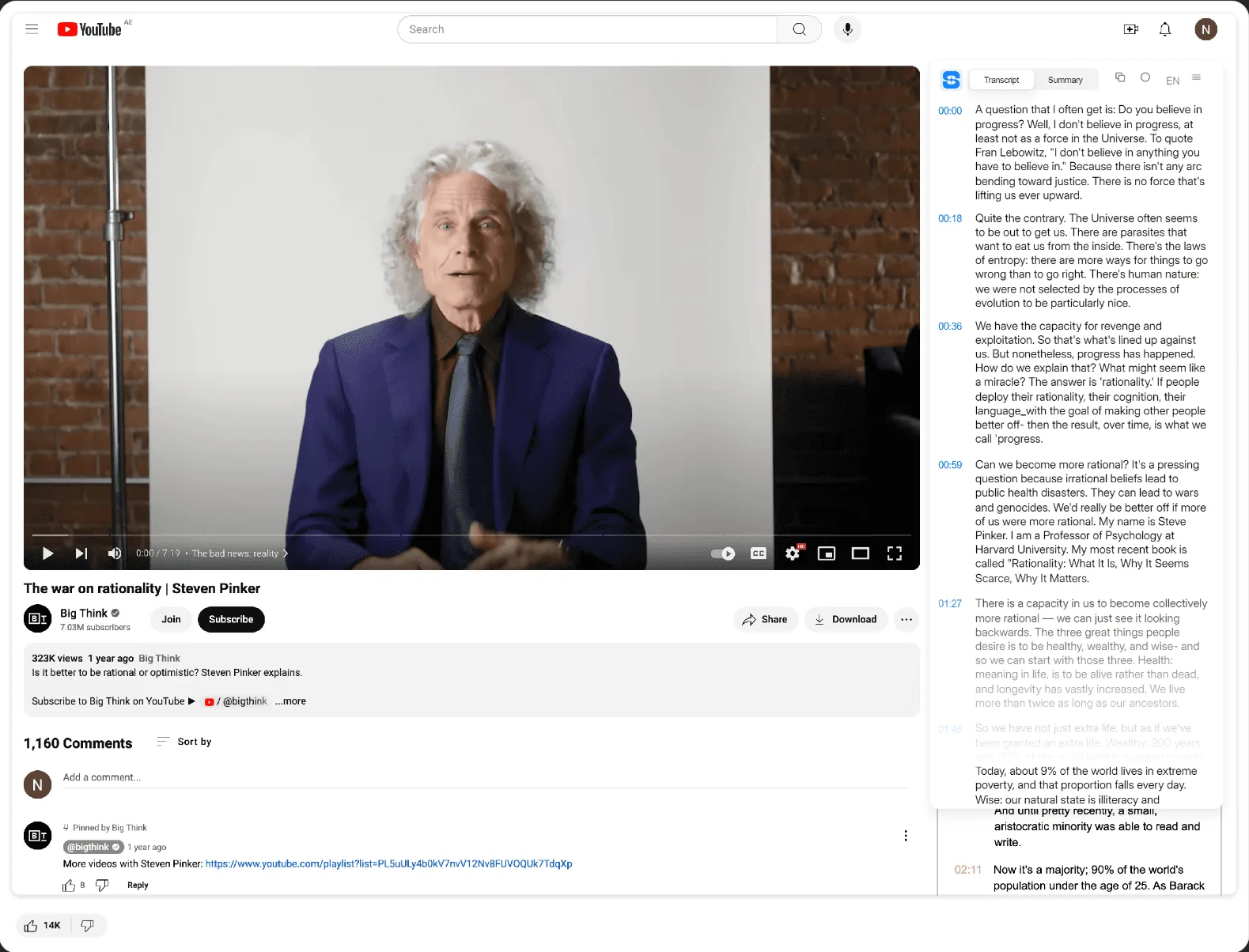
Transcript
Summary
EN
00:00
A question that I often get is: Do you believe in progress? Well, I don't believe in progress, at least not as a force in the Universe. To quote Fran Lebowitz, "I don't believe in anything you have to believe in." Because there isn't any arc bending toward justice. There is no force that's lifting us ever upward.
00:18
Quite the contrary. The Universe often seems to be out to get us. There are parasites that want to eat us from the inside. There's the laws of entropy: there are more ways for things to go wrong than to go right. There's human nature: we were not selected by the processes of evolution to be particularly nice.
00:36
We have the capacity for revenge and exploitation. So that's what's lined up against us. But nonetheless, progress has happened. How do we explain that? What might seem like a miracle? The answer is 'rationality.' If people deploy their rationality, their cognition, their language_with the goal of making other people better off- then the result, over time, is what we call 'progress.
00:59
Can we become more rational? It's a pressing question because irrational beliefs lead to public health disasters. They can lead to wars and genocides. We'd really be better off if more of us were more rational. My name is Steve Pinker. I am a Professor of Psychology at Harvard University. My most recent book is called "Rationality: What It Is, Why It Seems Scarce, Why It Matters.
01:27
There is a capacity in us to become collectively more rational — we can just see it looking backwards. The three great things people desire is to be healthy, wealthy, and wise- and so we can start with those three. Health: meaning in life, is to be alive rather than dead, and longevity has vastly increased. We live more than twice as long as our ancestors.
01:46
So we have not just extra life, but as if we've been granted an extra life. Wealthy: 200 years ago, 90% of the world lived in extreme poverty. Today, about 9% of the world lives in extreme poverty, and that proportion falls every day. Wise: our natural state is illiteracy and ignorance. And until pretty recently, a small, aristocratic minority was able to read and write.

สรุปวิดีโอด้วยพลัง AI
สรุปวิดีโอด้วยพลัง AI
สรุปวิดีโอได้ในไม่กี่วินาที ด้วยบทสรุปกระชับที่สร้างโดย AI
สรุปวิดีโอได้ในไม่กี่วินาที ด้วยบทสรุปกระชับที่สร้างโดย AI
Transcript
Summary
EN
Unlocking Progress: How Rationality Drives Human Advancemen
Exploring the Power of Rational Thinking in Overcoming Universal and Human Challenges
Exploring the Concept of Progress
in the Universe
A question that I often get is: Do you believe in progress? Well, I don’t believe in progress, at least not as a force in the Universe. To quote Fran Lebowitz, “I don’t believe in anything you have to believe in.” Because there isn’t any arc bending toward justice. There is no force that’s lifting us ever upward.
Challenges from Natural and Human Forces
Quite the contrary. The Universe often seems to be out to get us. There are parasites that want to eat us from the inside. There’s the laws of entropy: there are more ways for things to go wrong than to go right. There’s human nature: we were not selected by the processes of evolution to be particularly nice. We have the capacity for revenge and exploitation. So that’s what’s lined up against us.
How Rationality Explains Human Advancement
But nonetheless, progress has happened. How do we explain that? What might seem like a miracle? The answer is ‘rationality.’ If people deploy their rationality, their cognition, their language with the goal of making other people better off, then the result, over time, is what we call ‘progress.’
Post-Match Thoughts
• Reflections on the outcome and what it means for both teams moving forward.
• Speculation on how Team Liquid will fare against Gladiators in the grand final.
• Insights into the overall strategies and adjustments that may be needed for future matches.
Player and Team Dynamics
• Discussion on the mentality and preparation of players, including anecdotes about personal experiences and team dynamics.
• Mention of the importance of hygiene and professionalism in a team environment.
• Insights into how different players handle pressure and contribute to their team’s success.
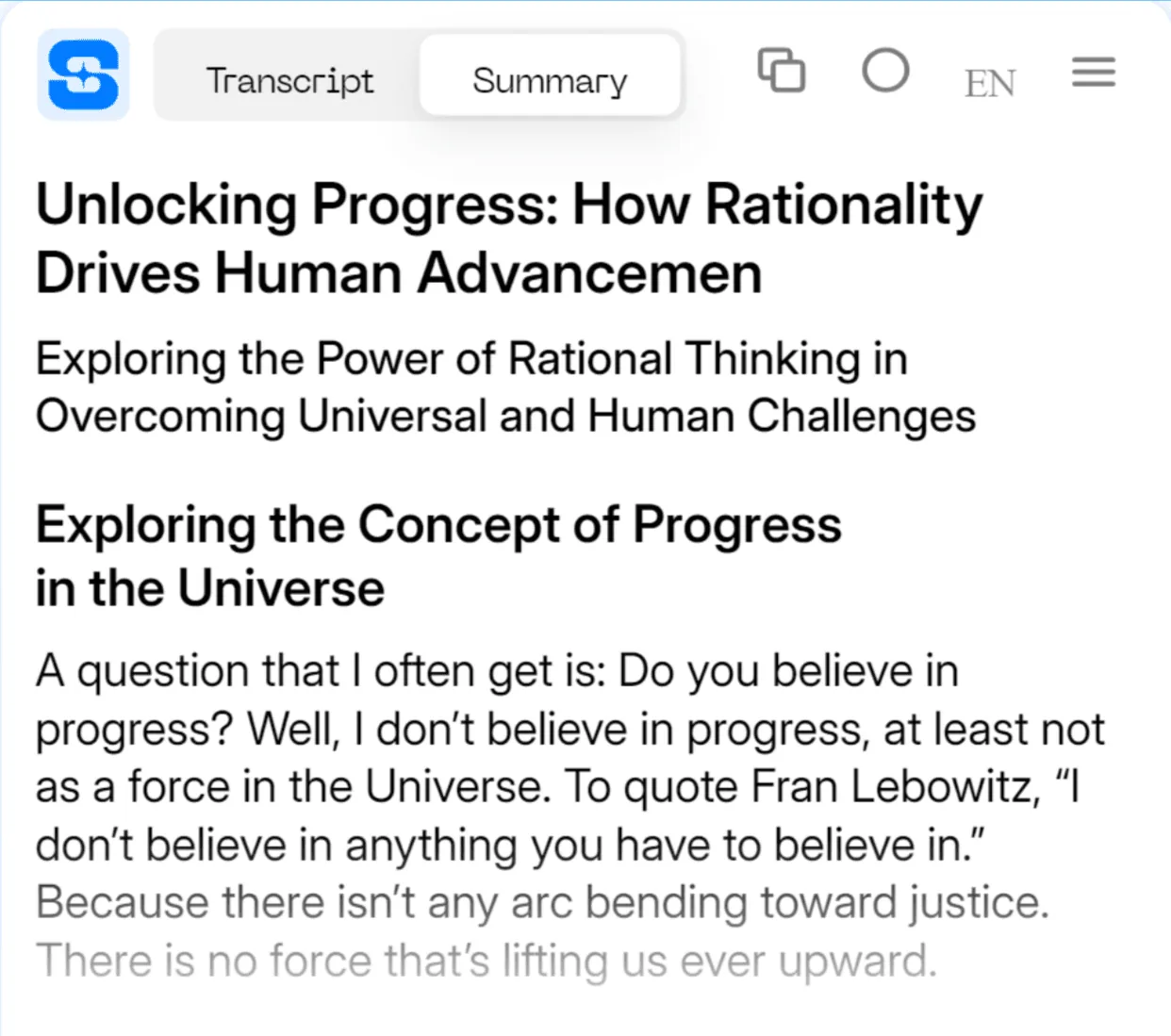
Transcript
Summary
EN
Unlocking Progress: How Rationality Drives Human Advancemen
Exploring the Power of Rational Thinking in Overcoming Universal and Human Challenges
Exploring the Concept of Progress
in the Universe
A question that I often get is: Do you believe in progress? Well, I don’t believe in progress, at least not as a force in the Universe. To quote Fran Lebowitz, “I don’t believe in anything you have to believe in.” Because there isn’t any arc bending toward justice. There is no force that’s lifting us ever upward.
Challenges from Natural and Human Forces
Quite the contrary. The Universe often seems to be out to get us. There are parasites that want to eat us from the inside. There’s the laws of entropy: there are more ways for things to go wrong than to go right. There’s human nature: we were not selected by the processes of evolution to be particularly nice. We have the capacity for revenge and exploitation. So that’s what’s lined up against us.
How Rationality Explains Human Advancement
But nonetheless, progress has happened. How do we explain that? What might seem like a miracle? The answer is ‘rationality.’ If people deploy their rationality, their cognition, their language with the goal of making other people better off, then the result, over time, is what we call ‘progress.’
Post-Match Thoughts
• Reflections on the outcome and what it means for both teams moving forward.
• Speculation on how Team Liquid will fare against Gladiators in the grand final.
• Insights into the overall strategies and adjustments that may be needed for future matches.
Player and Team Dynamics
• Discussion on the mentality and preparation of players, including anecdotes about personal experiences and team dynamics.
• Mention of the importance of hygiene and professionalism in a team environment.
• Insights into how different players handle pressure and contribute to their team’s success.

จับประเด็นสำคัญได้อย่างรวดเร็ว
จับประเด็นสำคัญได้อย่างรวดเร็ว
แตกประเด็นสำคัญออกมาเป็น
ย่อหน้าที่เรียบเรียงอย่างดี
แตกประเด็นสำคัญออกมาเป็น
ย่อหน้าที่เรียบเรียงอย่างดี
Transcript
Summary
new
EN
Key Ideas Breakdown
Belief in Progress
Steven Pinker addresses the question of whether he believes in progress. He cites Fran Lebowitz, expressing skepticism about progress as an inherent force in the Universe. Pinker argues that there is no natural arc bending towards justice or improvement, and he emphasizes that progress is not guaranteed.
Challenges from the Universe
Pinker describes various adversities that seem to challenge human existence. He mentions natural threats such as parasites that can harm us internally and the laws of entropy, which suggest that there are more ways for things to go wrong than right. Additionally, he points out that human nature, shaped by evolution, includes tendencies towards revenge and exploitation.


ติดตั้งง่าย
ติดตั้งง่าย
ส่วนขยาย Chrome ที่เรียบง่าย ติดตั้งไว ใช้งานง่าย
ส่วนขยาย Chrome ที่เรียบง่าย ติดตั้งไว ใช้งานง่าย
แปลได้ 50+ ภาษา
แปลได้ 50+ ภาษา
แปลข้อความถอดเสียงและบทสรุปได้ฟรีทุกภาษา
แปลข้อความถอดเสียงและบทสรุปได้ฟรีทุกภาษา
🇬🇧 English
🇨🇳 Mandarin Chinese
🇪🇸 Spanish
🇪🇸 Spanish
🇮🇳 Hindi
🇵🇹 Portuguese
🇯🇵 Japanese
🇫🇷 French
🇩🇪 German
🇰🇷 Korean
🇰🇷 Korean
🇺🇦 Ukrainian
🇹🇷 Turkish
🇨🇳 Mandarin Chinese
🇨🇳 Mandarin Chinese
ติดตั้งส่วนขยาย Chrome
รีวิว Scripsy เครื่องมือสรุป YouTube:
ทำไมผู้ใช้ถึงรักเรา
Scripsy สรุป YouTube
รีวิวจากผู้ใช้:
ทำไมผู้ใช้ถึงรักเรา
รีวิว

เครื่องมือที่มีประโยชน์มากสำหรับดึงประเด็นสำคัญจากวิดีโอ YouTube แบบเร็วๆ บทสรุปจาก AI ช่วยประหยัดเวลาได้เยอะมาก

ขอบคุณสำหรับส่วนขยายนี้! อินเทอร์เฟซสวย ใช้ง่าย ติดตั้งง่าย ของมันต้องมีสำหรับคนที่ใช้ YouTube ทำงานหรือเรียน

เครื่องมือถอดเสียงที่เยี่ยมมาก! ใช้ได้ทุกที่ใน youtube และถอดเสียงได้หลายภาษา ประหยัดเวลาดูวิดีโอยาวๆ กับเลกเชอร์ไปได้เยอะมาก ขอบคุณนะ!

ใช้ง่ายสุดๆ Scripsy สร้างข้อความถอดเสียงและสรุปได้ในไม่กี่วินาที เจ๋งมาก ตัวสรุปช่วยประหยัดเวลาไปได้เยอะมากกับพอดแคสต์ยาวๆ และพวกคลิปข่าว ชอบเลย!

ขอบคุณสำหรับส่วนขยายนี้! อินเทอร์เฟซสวย ใช้ง่าย ติดตั้งง่าย ของมันต้องมีสำหรับคนที่ใช้ YouTube ทำงานหรือเรียนแบบเรา

สุดยอดเครื่องมือสรุป YouTube ดีไซน์สวยมาก! ชอบที่สุดเท่าที่เคยใช้ ทั้งไวและแม่นยำ เหมาะมากเวลาอยากจับใจความเร็วๆ ตอนที่วิดีโอยาวเกินไป

ส่วนขยายดีมาก เครื่องมือถอดเสียงฟรีที่ดีที่สุดเท่าที่เคยมีมา!

ส่วนขยายแนวนี้ที่ดีที่สุดเท่าที่เคยเจอมา!!! ขอบคุณมากๆ ทำดีแบบนี้ต่อไปนะ💪🏻🔥

ว้าว!

ช่วยให้ทำงานได้มีประสิทธิภาพขึ้นมาก ตอนนี้ดูวิดีโอได้ง่ายขึ้นเยอะ ขอบคุณนะ!
อ่านรีวิวเพิ่มเติม

ใช้ง่ายและมีประโยชน์ ถ้ารองรับโหมดมืดด้วยจะยิ่งใช้งานดีขึ้นไปอีก

Nosky ★★★★★
ขอบคุณสำหรับส่วนขยายนี้! อินเทอร์เฟซสวย ใช้ง่าย ติดตั้งง่าย ของมันต้องมีสำหรับคนที่ใช้ YouTube ทำงานหรือเรียน

Sophie W.
ส่วนขยายแนวนี้ที่ดีที่สุดเท่าที่เคยเจอมา!!! ขอบคุณมากๆ ทำดีแบบนี้ต่อไปนะ💪🏻🔥

Bogdan Peregubko
เลือกแผนสรุป YouTube ของคุณ
เลือกแผนของคุณ

แผนรายเดือน
ถอดเสียง & สรุปวิดีโอไม่จำกัด
$
8.99
/
ต่อเดือน
ถอดเสียงไม่จำกัด
สรุปไม่จำกัด
เข้าถึงฟีเจอร์ใหม่
ยอดนิยม
เลือกแผนนี้
แผนรายปี
คุ้มที่สุดสำหรับการสรุปด้วย AI
$
4.16
/
ต่อเดือน
ชำระรายปี
ทดลองใช้ฟรี 7 วัน
ถอดเสียงไม่จำกัด
สรุปไม่จำกัด
เข้าถึงฟีเจอร์ใหม่
สุดคุ้ม
ประหยัด 35%
เริ่มทดลองใช้ฟรี
เริ่มทดลองใช้ฟรี
คำถามที่พบบ่อย
คำถามที่พบบ่อย
Scripsy AI คืออะไร?
ติดตั้งส่วนขยาย Chrome ของ Scripsy เพื่อถอดเสียงและสรุป YouTube ได้อย่างไร?
Scripsy ใช้ฟรีไหม?
มีช่วงทดลองใช้สำหรับการสรุปแบบไม่จำกัดไหม?
แผนฟรีสร้างบทสรุปด้วย AI ได้กี่ครั้ง?
รับข้อความถอดเสียงและบทสรุปเป็นภาษาอื่นได้ไหม?
ถอดเสียงวิดีโอแบบไหนได้บ้าง?
สร้างข้อความถอดเสียงใช้เวลานานแค่ไหน?
ติดตามเรา 🫦


