

Risparmia tempo e cogli le idee chiave dei video YouTube
Risparmia tempo e cogli le idee chiave dei video YouTube
Trascrivi e riassumi video YouTube & podcast in pochi secondi. Provalo gratis!
Trascrizioni e riassunti istantanei per YouTube — Disponibile su desktop
Accesso immediato. Nessuna carta di credito richiesta.
Trascrizioni e riassunti istantanei per YouTube — Disponibile su desktop

Transcript
Summary
EN
Short Description:
Tal Ben-Shahar explains that true happiness isn’t about avoiding pain but embracing challenges to grow stronger — a concept called antifragility. Instead of directly chasing happiness, which can backfire, we should focus on five key areas: spiritual purpose, physical recovery, intellectual curiosity, strong relationships, and emotional resilience. By cultivating these, we indirectly increase happiness and learn to make the best of life's hardships.
Timestamped Summary:
00:00 - 00:26 – Happiness Misconception: Painful emotions are unavoidable; only psychopaths or the dead feel no pain. Happiness doesn’t mean constant



Funzionalità potenti
Funzionalità potenti


Trascrivi video YouTube gratis
Trascrivi video YouTube gratis
Trascrivi video
YouTube gratis
Ottieni trascrizioni ultrarapide con timestamp precisi — in meno di 1 sec.
Trascrivi qualsiasi video in testo con timestamp precisi. Solo su Chrome desktop
Trascrizioni ultrarapide con timestamp precisi in meno di 1 secondo.
Transcript
Summary
EN
00:00
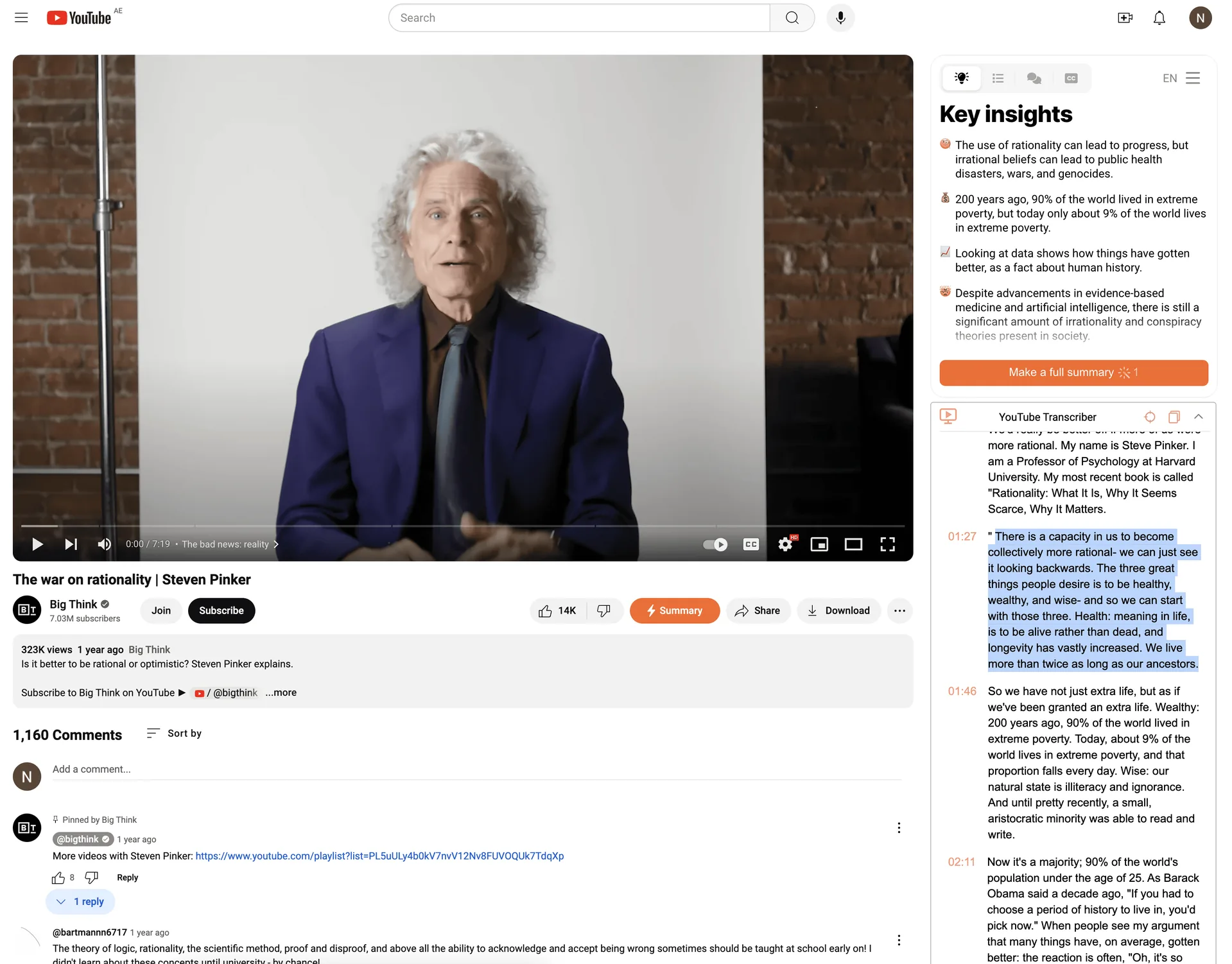
A question that I often get is: Do you believe in progress? Well, I don't believe in progress, at least not as a force in the Universe. To quote Fran Lebowitz, "I don't believe in anything you have to believe in." Because there isn't any arc bending toward justice. There is no force that's lifting us ever upward.
00:18
Quite the contrary. The Universe often seems to be out to get us. There are parasites that want to eat us from the inside. There's the laws of entropy: there are more ways for things to go wrong than to go right. There's human nature: we were not selected by the processes of evolution to be particularly nice.
00:36
We have the capacity for revenge and exploitation. So that's what's lined up against us. But nonetheless, progress has happened. How do we explain that? What might seem like a miracle? The answer is 'rationality.' If people deploy their rationality, their cognition, their language_with the goal of making other people better off- then the result, over time, is what we call 'progress.
00:59
Can we become more rational? It's a pressing question because irrational beliefs lead to public health disasters. They can lead to wars and genocides. We'd really be better off if more of us were more rational. My name is Steve Pinker. I am a Professor of Psychology at Harvard University. My most recent book is called "Rationality: What It Is, Why It Seems Scarce, Why It Matters.
01:27
There is a capacity in us to become collectively more rational — we can just see it looking backwards. The three great things people desire is to be healthy, wealthy, and wise- and so we can start with those three. Health: meaning in life, is to be alive rather than dead, and longevity has vastly increased. We live more than twice as long as our ancestors.
01:46
So we have not just extra life, but as if we've been granted an extra life. Wealthy: 200 years ago, 90% of the world lived in extreme poverty. Today, about 9% of the world lives in extreme poverty, and that proportion falls every day. Wise: our natural state is illiteracy and ignorance. And until pretty recently, a small, aristocratic minority was able to read and write.

Transcript
Summary
EN
00:00
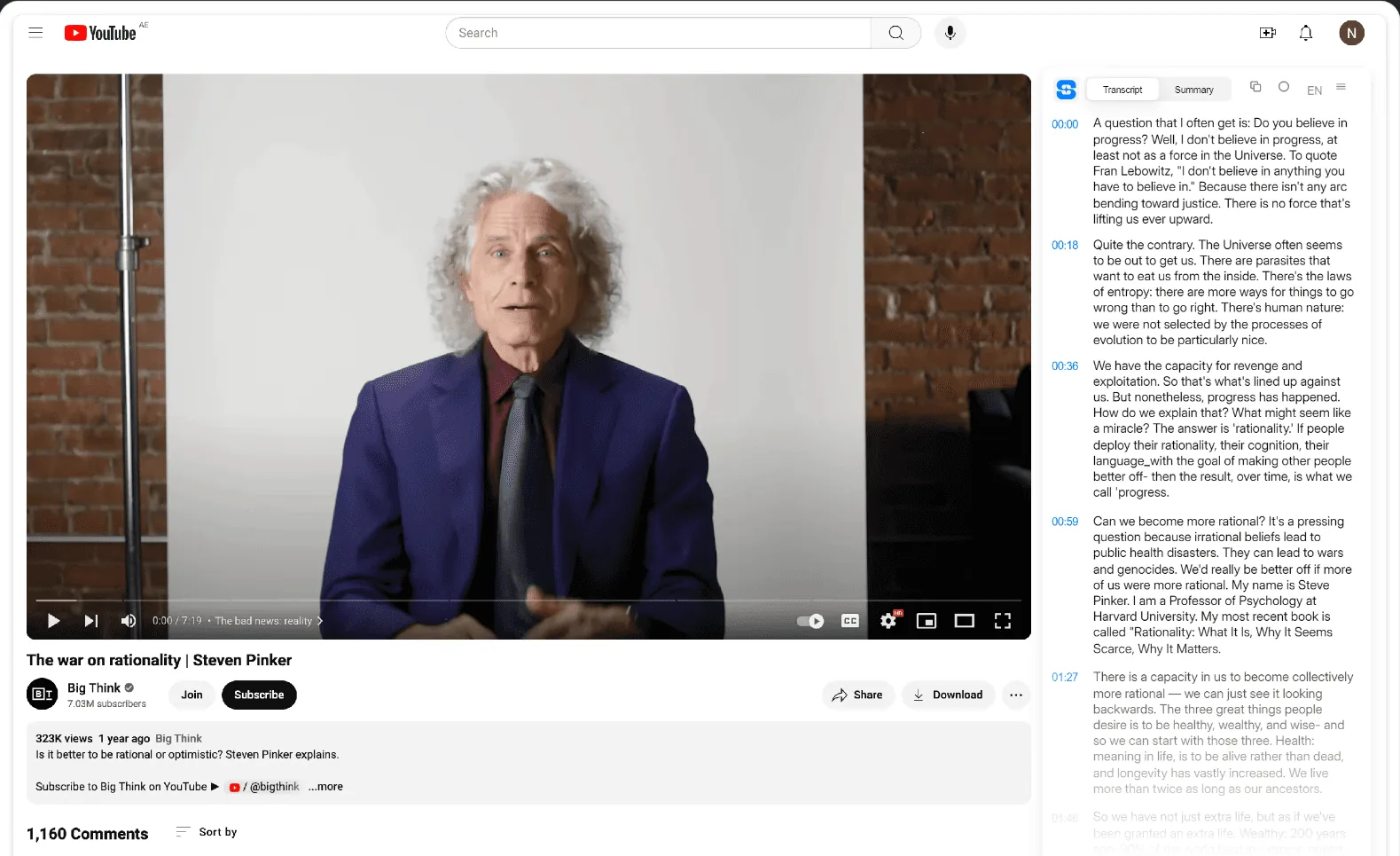
A question that I often get is: Do you believe in progress? Well, I don't believe in progress, at least not as a force in the Universe. To quote Fran Lebowitz, "I don't believe in anything you have to believe in." Because there isn't any arc bending toward justice. There is no force that's lifting us ever upward.
00:18
Quite the contrary. The Universe often seems to be out to get us. There are parasites that want to eat us from the inside. There's the laws of entropy: there are more ways for things to go wrong than to go right. There's human nature: we were not selected by the processes of evolution to be particularly nice.
00:36
We have the capacity for revenge and exploitation. So that's what's lined up against us. But nonetheless, progress has happened. How do we explain that? What might seem like a miracle? The answer is 'rationality.' If people deploy their rationality, their cognition, their language_with the goal of making other people better off- then the result, over time, is what we call 'progress.
00:59
Can we become more rational? It's a pressing question because irrational beliefs lead to public health disasters. They can lead to wars and genocides. We'd really be better off if more of us were more rational. My name is Steve Pinker. I am a Professor of Psychology at Harvard University. My most recent book is called "Rationality: What It Is, Why It Seems Scarce, Why It Matters.
01:27
There is a capacity in us to become collectively more rational — we can just see it looking backwards. The three great things people desire is to be healthy, wealthy, and wise- and so we can start with those three. Health: meaning in life, is to be alive rather than dead, and longevity has vastly increased. We live more than twice as long as our ancestors.
01:46
So we have not just extra life, but as if we've been granted an extra life. Wealthy: 200 years ago, 90% of the world lived in extreme poverty. Today, about 9% of the world lives in extreme poverty, and that proportion falls every day. Wise: our natural state is illiteracy and ignorance. And until pretty recently, a small, aristocratic minority was able to read and write.
Transcript
Summary
EN
00:00
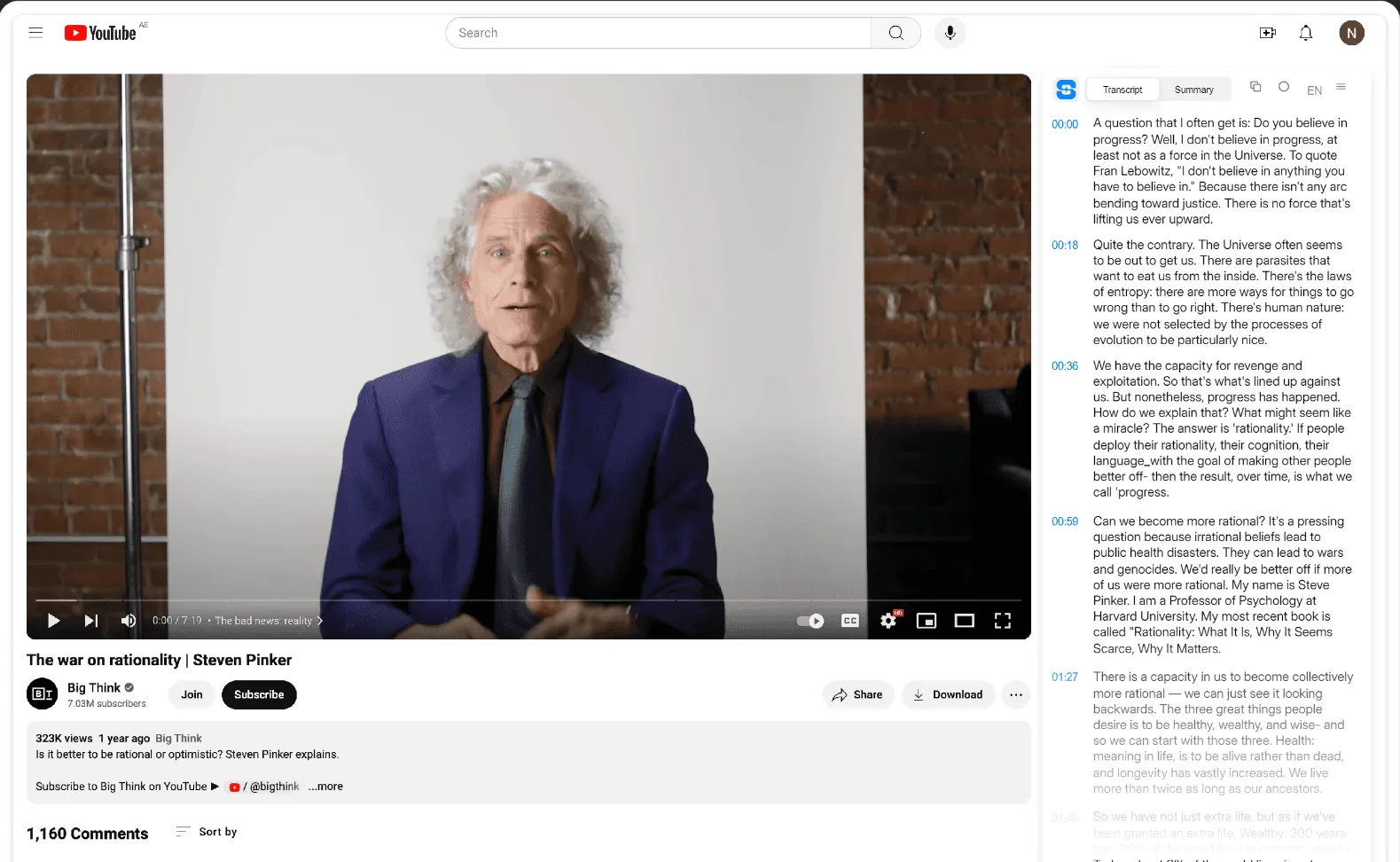
A question that I often get is: Do you believe in progress? Well, I don't believe in progress, at least not as a force in the Universe. To quote Fran Lebowitz, "I don't believe in anything you have to believe in." Because there isn't any arc bending toward justice. There is no force that's lifting us ever upward.
00:18
Quite the contrary. The Universe often seems to be out to get us. There are parasites that want to eat us from the inside. There's the laws of entropy: there are more ways for things to go wrong than to go right. There's human nature: we were not selected by the processes of evolution to be particularly nice.
00:36
We have the capacity for revenge and exploitation. So that's what's lined up against us. But nonetheless, progress has happened. How do we explain that? What might seem like a miracle? The answer is 'rationality.' If people deploy their rationality, their cognition, their language_with the goal of making other people better off- then the result, over time, is what we call 'progress.
00:59
Can we become more rational? It's a pressing question because irrational beliefs lead to public health disasters. They can lead to wars and genocides. We'd really be better off if more of us were more rational. My name is Steve Pinker. I am a Professor of Psychology at Harvard University. My most recent book is called "Rationality: What It Is, Why It Seems Scarce, Why It Matters.
01:27
There is a capacity in us to become collectively more rational — we can just see it looking backwards. The three great things people desire is to be healthy, wealthy, and wise- and so we can start with those three. Health: meaning in life, is to be alive rather than dead, and longevity has vastly increased. We live more than twice as long as our ancestors.
01:46
So we have not just extra life, but as if we've been granted an extra life. Wealthy: 200 years ago, 90% of the world lived in extreme poverty. Today, about 9% of the world lives in extreme poverty, and that proportion falls every day. Wise: our natural state is illiteracy and ignorance. And until pretty recently, a small, aristocratic minority was able to read and write.

Risparmia tempo su video lunghi e podcast
Risparmia tempo su video lunghi e podcast
Riassumi i video YouTube in pochi secondi con sintesi concise
Riassumi i video YouTube in pochi secondi con sintesi concise
Transcript
Summary
EN
The Three Desires: Health, Wealth, and Wisdom
Health 🌱
- Life expectancy has more than doubled in the last two centuries.
- Emphasizes that we are living extended lives compared to our ancestors.
Wealth 💰
- Historical decline in extreme poverty: from 90% to about 9% in modern times.
- Notable improvement in overall wealth distribution.
- Increase in literacy, now around 90% of the global population under age 25 can read and write.
Exploring the Concept of Progress
in the Universe
A question that I often get is: Do you believe in progress? Well, I don’t believe in progress, at least not as a force in the Universe. To quote Fran Lebowitz, “I don’t believe in anything you have to believe in.” Because there isn’t any arc bending toward justice. There is no force that’s lifting us ever upward.
Challenges from Natural and Human Forces
Quite the contrary. The Universe often seems to be out to get us. There are parasites that want to eat us from the inside. There’s the laws of entropy: there are more ways for things to go wrong than to go right. There’s human nature: we were not selected by the processes of evolution to be particularly nice. We have the capacity for revenge and exploitation. So that’s what’s lined up against us.
How Rationality Explains Human Advancement
But nonetheless, progress has happened. How do we explain that? What might seem like a miracle? The answer is ‘rationality.’ If people deploy their rationality, their cognition, their language with the goal of making other people better off, then the result, over time, is what we call ‘progress.’
Post-Match Thoughts
• Reflections on the outcome and what it means for both teams moving forward.
• Speculation on how Team Liquid will fare against Gladiators in the grand final.
• Insights into the overall strategies and adjustments that may be needed for future matches.
Player and Team Dynamics
• Discussion on the mentality and preparation of players, including anecdotes about personal experiences and team dynamics.
• Mention of the importance of hygiene and professionalism in a team environment.
• Insights into how different players handle pressure and contribute to their team’s success.
Transcript
Summary
EN
The Three Desires: Health, Wealth, and Wisdom
Health 🌱
- Life expectancy has more than doubled in the last two centuries.
- Emphasizes that we are living extended lives compared to our ancestors.
Wealth 💰
- Historical decline in extreme poverty: from 90% to about 9% in modern times.
- Notable improvement in overall wealth distribution.
- Increase in literacy, now around 90% of the global population under age 25 can read and write.
Exploring the Concept of Progress
in the Universe
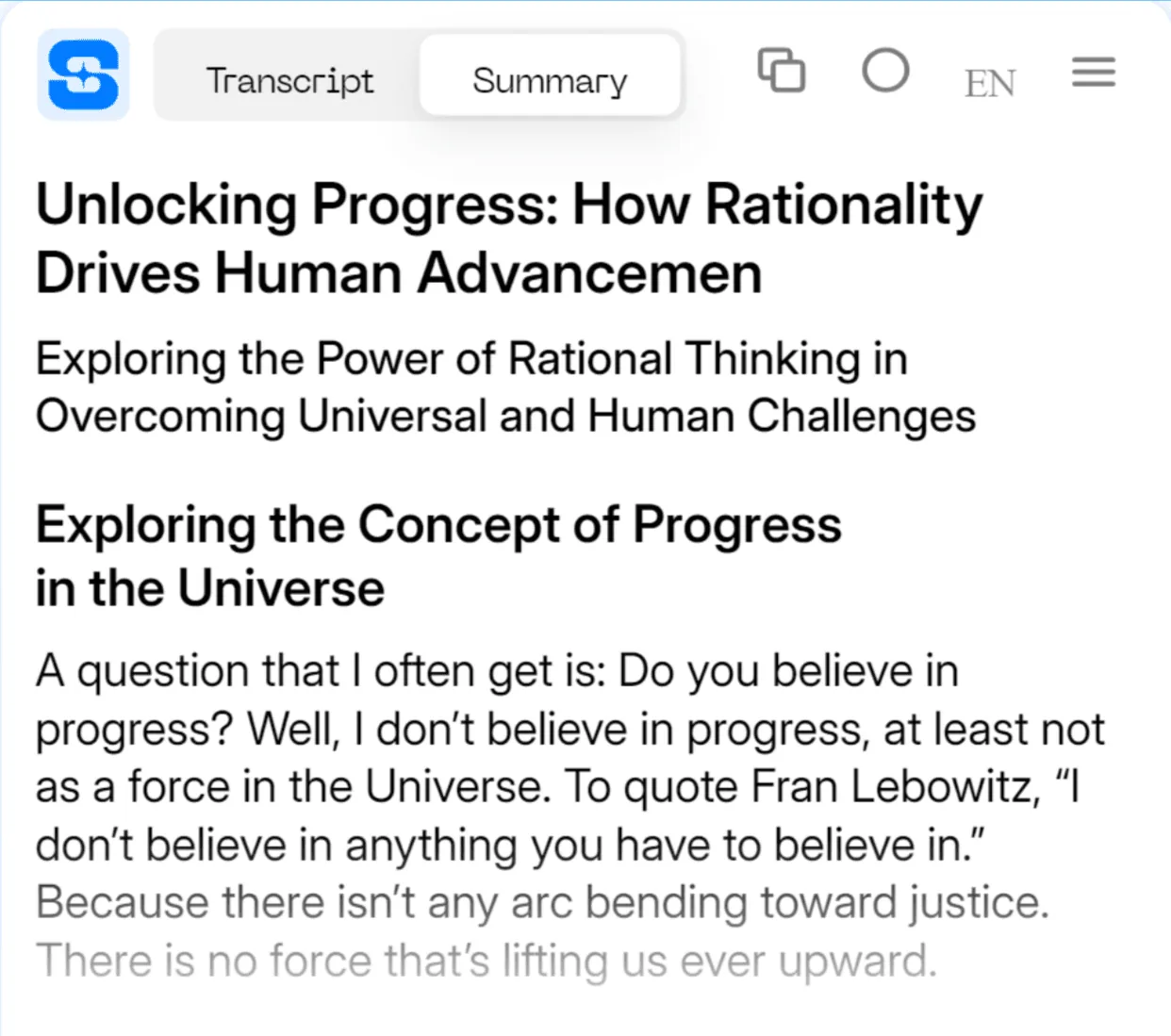
A question that I often get is: Do you believe in progress? Well, I don’t believe in progress, at least not as a force in the Universe. To quote Fran Lebowitz, “I don’t believe in anything you have to believe in.” Because there isn’t any arc bending toward justice. There is no force that’s lifting us ever upward.
Challenges from Natural and Human Forces
Quite the contrary. The Universe often seems to be out to get us. There are parasites that want to eat us from the inside. There’s the laws of entropy: there are more ways for things to go wrong than to go right. There’s human nature: we were not selected by the processes of evolution to be particularly nice. We have the capacity for revenge and exploitation. So that’s what’s lined up against us.
How Rationality Explains Human Advancement
But nonetheless, progress has happened. How do we explain that? What might seem like a miracle? The answer is ‘rationality.’ If people deploy their rationality, their cognition, their language with the goal of making other people better off, then the result, over time, is what we call ‘progress.’
Post-Match Thoughts
• Reflections on the outcome and what it means for both teams moving forward.
• Speculation on how Team Liquid will fare against Gladiators in the grand final.
• Insights into the overall strategies and adjustments that may be needed for future matches.
Player and Team Dynamics
• Discussion on the mentality and preparation of players, including anecdotes about personal experiences and team dynamics.
• Mention of the importance of hygiene and professionalism in a team environment.
• Insights into how different players handle pressure and contribute to their team’s success.

Cogli subito idee chiave e spunti
Cogli subito idee chiave e spunti
Scomponi le idee chiave di ogni video YouTube
in paragrafi ben strutturati
Scomponi le idee chiave di ogni video YouTube
in paragrafi ben strutturati
Transcript
Summary
new
EN
Key Ideas Breakdown
Belief in Progress
Rationality is key to understanding and improving society.
Significant improvements in health, wealth, and wisdom can be observed via a rational lens.
Focus on evidence and critical thinking to foster a more knowledgeable population.
Progress is possible, but it's a collective journey rather than a guaranteed outcome.
Actionable Advice:
Embrace data and long-term trends rather than getting caught up in sensational news.
Integrate principles of rationality and critical thinking into everyday discussions and writings.
Participate actively in rational discourse to counteract misinformation and promote better understanding.



Riassunti
con timestamp
Riassunti
con timestamp
Capisci subito ogni capitolo
senza guardare tutto il video.
Capisci subito ogni capitolo
senza guardare tutto il video.
Trascrizioni e riassunti in 50+ lingue
Trascrizioni e riassunti in 50+ lingue
Ottieni trascrizioni e riassunti in tutte le lingue disponibili nei sottotitoli
Ottieni trascrizioni e riassunti in tutte le lingue disponibili nei sottotitoli
🇬🇧 English
🇪🇸 Spanish
🇪🇸 Spanish
🇫🇷 French
🇩🇪 German
🇨🇳 Mandarin Chinese
🇯🇵 Japanese
🇵🇹 Portuguese
🇮🇳 Hindi
🇰🇷 Korean
🇰🇷 Korean
🇺🇦 Ukrainian
🇹🇷 Turkish
🇨🇳 Mandarin Chinese
🇨🇳 Mandarin Chinese
Installa l'estensione Chrome
Perché Scripsy è il #1:
Le recensioni degli utenti
Recensioni

Strumento utile per estrarre rapidamente i punti chiave dai video di YouTube. I riassunti generati dall'IA fanno risparmiare un sacco di tempo.

Grazie per questa estensione! Interfaccia bellissima, facile da usare, facile da installare. Indispensabile per chi usa YouTube per lavoro o studio.

Ottimo generatore di trascrizioni! funziona ovunque su youtube e ti dà la trascrizione in diverse lingue. Ho risparmiato un sacco di tempo con video lunghi e lezioni, grazie!

Super semplice da usare. Scripsy genera trascrizione e riassunto in pochi secondi, ed è fantastico. Il riassunto fa risparmiare un sacco di tempo con i podcast lunghi e i video tipo notiziari. Mi piace!

Grazie per questa estensione! Interfaccia bellissima, facile da usare, facile da installare. Indispensabile per chi usa YouTube per lavoro o studio, come me

Il top per riassumere YouTube, con un design fantastico! Il mio preferito finora, è veloce e preciso, perfetto per cogliere il succo quando il video è troppo lungo

Ottima estensione. Il miglior trascrittore gratuito di sempre!

La migliore estensione del suo genere finora!!! Grazie mille, continuate così💪🏻🔥

WOW!

mi ha reso molto produttivo, ora è più facile guardare i video, grazie!
Leggi altre testimonianze

Facile da usare e utile. Aggiungere il supporto per la modalità scura migliorerebbe l'esperienza.

Nosky ★★★★★
Grazie per questa estensione! Interfaccia bellissima, facile da usare, facile da installare. Indispensabile per chi usa YouTube per lavoro o studio.

Sophie W.
La migliore estensione del suo genere finora!!! Grazie mille, continuate così💪🏻🔥

Bogdan Peregubko
Domande frequenti
Domande frequenti
Che cos'è Scripsy AI?
Come si installa l'estensione Chrome Scripsy per trascrizioni e riassunti di YouTube?
Scripsy è gratuito?
È disponibile una prova per i riassunti illimitati?
Quanti riassunti IA posso generare con il piano gratuito?
Posso ottenere trascrizioni e riassunti in lingue diverse?
Quali video posso trascrivere?
Quanto tempo ci vuole per creare una trascrizione?
Segui le novità
Seguici


