

Comment résumer une vidéo YouTube
avec l'IA
Comment résumer une vidéo YouTube
avec l'IA
Transcrivez et résumez vos vidéos YouTube
& podcasts en quelques secondes. Essayez gratuitement !
Transcript
Summary
EN
Short Description:
Tal Ben-Shahar explains that true happiness isn’t about avoiding pain but embracing challenges to grow stronger — a concept called antifragility. Instead of directly chasing happiness, which can backfire, we should focus on five key areas: spiritual purpose, physical recovery, intellectual curiosity, strong relationships, and emotional resilience. By cultivating these, we indirectly increase happiness and learn to make the best of life's hardships.
Timestamped Summary:
00:00 - 00:26 – Happiness Misconception: Painful emotions are unavoidable; only psychopaths or the dead feel no pain. Happiness doesn’t mean constant



Libérez la puissance
de Scripsy AI
Libérez la puissance
de Scripsy AI


Transcrivez vos vidéos YouTube gratuitement
Transcrivez vos vidéos YouTube gratuitement
Transcrivez n'importe quelle vidéo en texte avec des horodatages précis. Gratuit. Pour toujours.
Transcrivez n'importe quelle vidéo en texte avec des horodatages précis. Gratuit. Pour toujours.
Transcript
Summary
EN
00:00
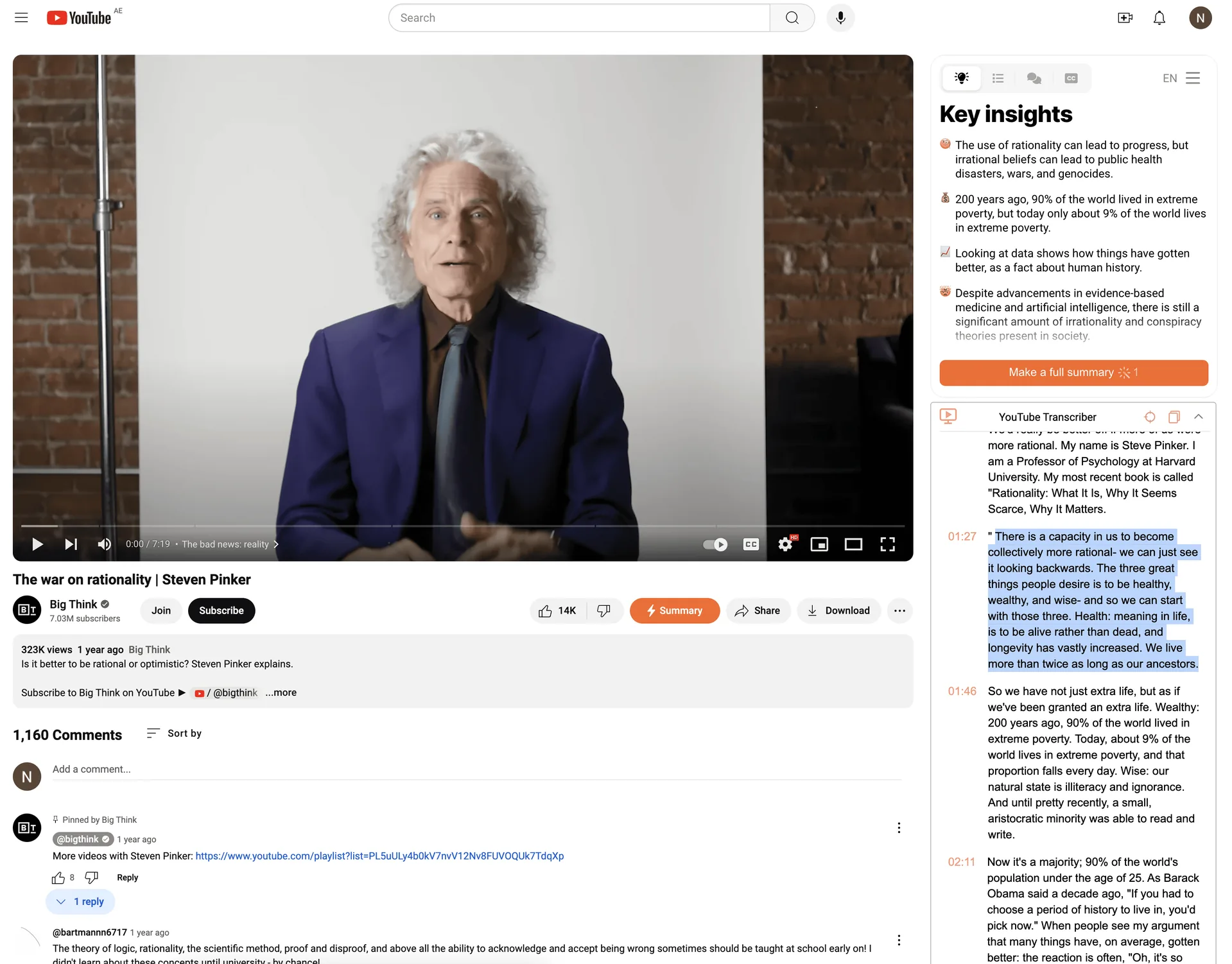
A question that I often get is: Do you believe in progress? Well, I don't believe in progress, at least not as a force in the Universe. To quote Fran Lebowitz, "I don't believe in anything you have to believe in." Because there isn't any arc bending toward justice. There is no force that's lifting us ever upward.
00:18
Quite the contrary. The Universe often seems to be out to get us. There are parasites that want to eat us from the inside. There's the laws of entropy: there are more ways for things to go wrong than to go right. There's human nature: we were not selected by the processes of evolution to be particularly nice.
00:36
We have the capacity for revenge and exploitation. So that's what's lined up against us. But nonetheless, progress has happened. How do we explain that? What might seem like a miracle? The answer is 'rationality.' If people deploy their rationality, their cognition, their language_with the goal of making other people better off- then the result, over time, is what we call 'progress.
00:59
Can we become more rational? It's a pressing question because irrational beliefs lead to public health disasters. They can lead to wars and genocides. We'd really be better off if more of us were more rational. My name is Steve Pinker. I am a Professor of Psychology at Harvard University. My most recent book is called "Rationality: What It Is, Why It Seems Scarce, Why It Matters.
01:27
There is a capacity in us to become collectively more rational — we can just see it looking backwards. The three great things people desire is to be healthy, wealthy, and wise- and so we can start with those three. Health: meaning in life, is to be alive rather than dead, and longevity has vastly increased. We live more than twice as long as our ancestors.
01:46
So we have not just extra life, but as if we've been granted an extra life. Wealthy: 200 years ago, 90% of the world lived in extreme poverty. Today, about 9% of the world lives in extreme poverty, and that proportion falls every day. Wise: our natural state is illiteracy and ignorance. And until pretty recently, a small, aristocratic minority was able to read and write.

Transcript
Summary
EN
00:00
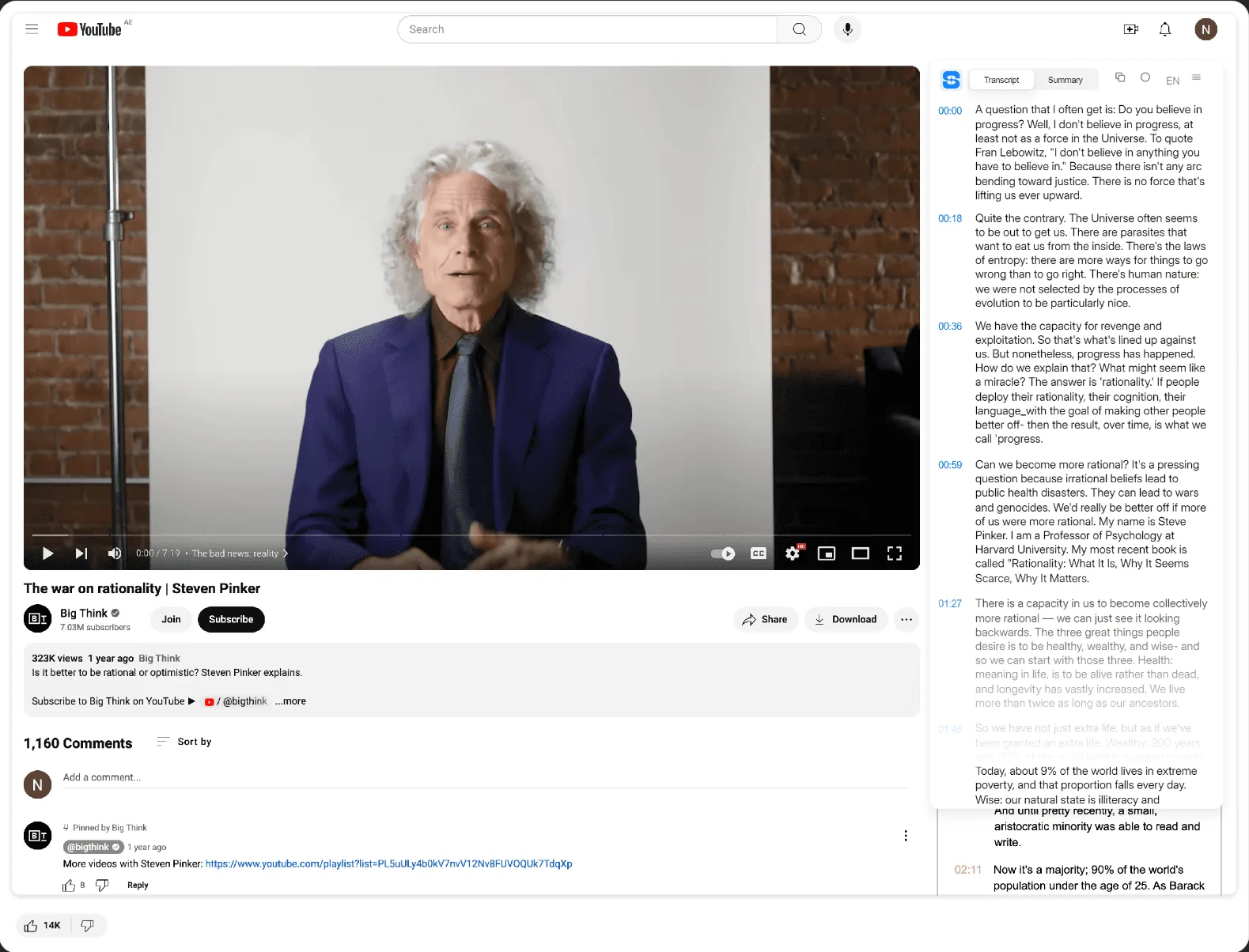
A question that I often get is: Do you believe in progress? Well, I don't believe in progress, at least not as a force in the Universe. To quote Fran Lebowitz, "I don't believe in anything you have to believe in." Because there isn't any arc bending toward justice. There is no force that's lifting us ever upward.
00:18
Quite the contrary. The Universe often seems to be out to get us. There are parasites that want to eat us from the inside. There's the laws of entropy: there are more ways for things to go wrong than to go right. There's human nature: we were not selected by the processes of evolution to be particularly nice.
00:36
We have the capacity for revenge and exploitation. So that's what's lined up against us. But nonetheless, progress has happened. How do we explain that? What might seem like a miracle? The answer is 'rationality.' If people deploy their rationality, their cognition, their language_with the goal of making other people better off- then the result, over time, is what we call 'progress.
00:59
Can we become more rational? It's a pressing question because irrational beliefs lead to public health disasters. They can lead to wars and genocides. We'd really be better off if more of us were more rational. My name is Steve Pinker. I am a Professor of Psychology at Harvard University. My most recent book is called "Rationality: What It Is, Why It Seems Scarce, Why It Matters.
01:27
There is a capacity in us to become collectively more rational — we can just see it looking backwards. The three great things people desire is to be healthy, wealthy, and wise- and so we can start with those three. Health: meaning in life, is to be alive rather than dead, and longevity has vastly increased. We live more than twice as long as our ancestors.
01:46
So we have not just extra life, but as if we've been granted an extra life. Wealthy: 200 years ago, 90% of the world lived in extreme poverty. Today, about 9% of the world lives in extreme poverty, and that proportion falls every day. Wise: our natural state is illiteracy and ignorance. And until pretty recently, a small, aristocratic minority was able to read and write.

Résumés vidéo par IA
Résumés vidéo par IA
Résumez vos vidéos en quelques secondes grâce à des résumés concis générés par IA
Résumez vos vidéos en quelques secondes grâce à des résumés concis générés par IA
Transcript
Summary
EN
Unlocking Progress: How Rationality Drives Human Advancemen
Exploring the Power of Rational Thinking in Overcoming Universal and Human Challenges
Exploring the Concept of Progress
in the Universe
A question that I often get is: Do you believe in progress? Well, I don’t believe in progress, at least not as a force in the Universe. To quote Fran Lebowitz, “I don’t believe in anything you have to believe in.” Because there isn’t any arc bending toward justice. There is no force that’s lifting us ever upward.
Challenges from Natural and Human Forces
Quite the contrary. The Universe often seems to be out to get us. There are parasites that want to eat us from the inside. There’s the laws of entropy: there are more ways for things to go wrong than to go right. There’s human nature: we were not selected by the processes of evolution to be particularly nice. We have the capacity for revenge and exploitation. So that’s what’s lined up against us.
How Rationality Explains Human Advancement
But nonetheless, progress has happened. How do we explain that? What might seem like a miracle? The answer is ‘rationality.’ If people deploy their rationality, their cognition, their language with the goal of making other people better off, then the result, over time, is what we call ‘progress.’
Post-Match Thoughts
• Reflections on the outcome and what it means for both teams moving forward.
• Speculation on how Team Liquid will fare against Gladiators in the grand final.
• Insights into the overall strategies and adjustments that may be needed for future matches.
Player and Team Dynamics
• Discussion on the mentality and preparation of players, including anecdotes about personal experiences and team dynamics.
• Mention of the importance of hygiene and professionalism in a team environment.
• Insights into how different players handle pressure and contribute to their team’s success.
Transcript
Summary
EN
Unlocking Progress: How Rationality Drives Human Advancemen
Exploring the Power of Rational Thinking in Overcoming Universal and Human Challenges
Exploring the Concept of Progress
in the Universe
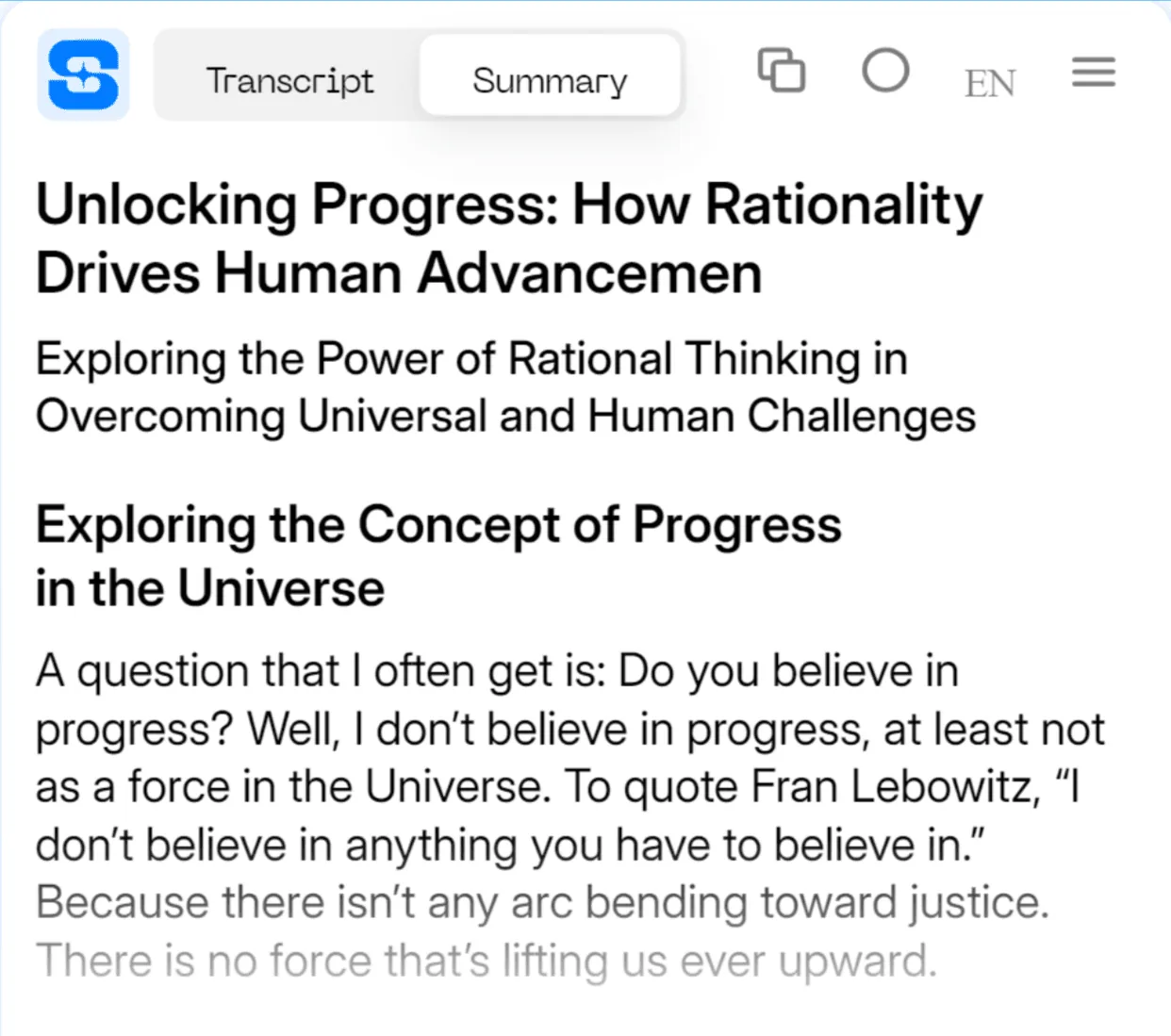
A question that I often get is: Do you believe in progress? Well, I don’t believe in progress, at least not as a force in the Universe. To quote Fran Lebowitz, “I don’t believe in anything you have to believe in.” Because there isn’t any arc bending toward justice. There is no force that’s lifting us ever upward.
Challenges from Natural and Human Forces
Quite the contrary. The Universe often seems to be out to get us. There are parasites that want to eat us from the inside. There’s the laws of entropy: there are more ways for things to go wrong than to go right. There’s human nature: we were not selected by the processes of evolution to be particularly nice. We have the capacity for revenge and exploitation. So that’s what’s lined up against us.
How Rationality Explains Human Advancement
But nonetheless, progress has happened. How do we explain that? What might seem like a miracle? The answer is ‘rationality.’ If people deploy their rationality, their cognition, their language with the goal of making other people better off, then the result, over time, is what we call ‘progress.’
Post-Match Thoughts
• Reflections on the outcome and what it means for both teams moving forward.
• Speculation on how Team Liquid will fare against Gladiators in the grand final.
• Insights into the overall strategies and adjustments that may be needed for future matches.
Player and Team Dynamics
• Discussion on the mentality and preparation of players, including anecdotes about personal experiences and team dynamics.
• Mention of the importance of hygiene and professionalism in a team environment.
• Insights into how different players handle pressure and contribute to their team’s success.

Obtenez vite les idées clés
Obtenez vite les idées clés
Décomposez les idées clés en
paragraphes bien structurés
Décomposez les idées clés en
paragraphes bien structurés
Transcript
Summary
new
EN
Key Ideas Breakdown
Belief in Progress
Steven Pinker addresses the question of whether he believes in progress. He cites Fran Lebowitz, expressing skepticism about progress as an inherent force in the Universe. Pinker argues that there is no natural arc bending towards justice or improvement, and he emphasizes that progress is not guaranteed.
Challenges from the Universe
Pinker describes various adversities that seem to challenge human existence. He mentions natural threats such as parasites that can harm us internally and the laws of entropy, which suggest that there are more ways for things to go wrong than right. Additionally, he points out that human nature, shaped by evolution, includes tendencies towards revenge and exploitation.


Facile à installer
Facile à installer
Une extension Chrome simple, rapide à installer et à utiliser
Une extension Chrome simple, rapide à installer et à utiliser
Traduisez en 50+ langues
Traduisez en 50+ langues
Traductions gratuites des transcriptions et des résumés dans toutes les langues
Traductions gratuites des transcriptions et des résumés dans toutes les langues
🇬🇧 English
🇨🇳 Mandarin Chinese
🇪🇸 Spanish
🇪🇸 Spanish
🇮🇳 Hindi
🇵🇹 Portuguese
🇯🇵 Japanese
🇫🇷 French
🇩🇪 German
🇰🇷 Korean
🇰🇷 Korean
🇺🇦 Ukrainian
🇹🇷 Turkish
🇨🇳 Mandarin Chinese
🇨🇳 Mandarin Chinese
Installer l'extension Chrome
Avis sur Scripsy, l'outil de résumé YouTube :
Pourquoi les utilisateurs nous adorent
Avis
Avis sur Scripsy,
l'outil de résumé YouTube :
Pourquoi les utilisateurs nous adorent

Outil pratique pour extraire rapidement l'essentiel des vidéos YouTube. Les résumés générés par IA font gagner beaucoup de temps.

Merci pour cette extension ! Belle interface, facile à utiliser, facile à installer. Indispensable pour ceux qui utilisent YouTube pour le travail ou les études.

Super générateur de transcriptions ! ça marche partout sur youtube et ça donne la transcription dans différentes langues. J'ai gagné plein de temps sur les longues vidéos et les cours, merci !

Super simple à utiliser. Scripsy génère une transcription et un résumé en quelques secondes, c'est cool. Le résumé fait gagner un temps fou sur les longs podcasts et les vidéos genre actu. J'adore !

Merci pour cette extension ! Belle interface, facile à utiliser, facile à installer. Indispensable pour ceux qui, comme moi, utilisent YouTube pour le travail ou les études

Top outil de résumé YouTube avec un super design ! Mon préféré jusqu'ici, rapide et précis, parfait pour saisir l'essentiel quand la vidéo est trop longue

Super extension. Le meilleur outil de transcription gratuit qui existe !

La meilleure extension du genre jusqu'ici !!! Merci beaucoup, continuez comme ça💪🏻🔥

WOW !

ça m'a rendu très productif, maintenant c'est plus facile de regarder des vidéos, merci !
Lire plus de témoignages

Facile à utiliser et pratique. Un mode sombre rendrait l'expérience encore meilleure.

Nosky ★★★★★
Merci pour cette extension ! Belle interface, facile à utiliser, facile à installer. Indispensable pour ceux qui utilisent YouTube pour le travail ou les études.

Sophie W.
La meilleure extension du genre jusqu'ici !!! Merci beaucoup, continuez comme ça💪🏻🔥

Bogdan Peregubko
Choisissez votre formule de résumé YouTube
Choisissez votre formule
Gratuit
Résumés limités
$
0
/
par mois
Transcriptions illimitées de vidéos YouTube
1 résumé gratuit par jour
Commencer gratuitement

Formule mensuelle
Transcriptions & résumés vidéo illimités
$
8.99
/
par mois
Transcriptions illimitées
Résumés illimités
Accès aux nouvelles fonctionnalités
Le plus populaire
Choisir cette formule
Formule annuelle
Résumés IA au meilleur prix
$
4.16
/
par mois
Facturé annuellement
Essai gratuit de 7 jours
Transcriptions illimitées
Résumés illimités
Accès aux nouvelles fonctionnalités
Bon plan
Économisez 35 %
Commencez avec un essai gratuit
Commencer l'essai gratuit
Questions fréquentes
Questions fréquentes
Qu'est-ce que Scripsy AI ?
Comment installer l'extension Chrome Scripsy pour les transcriptions et résumés YouTube ?
Scripsy est-il gratuit ?
Existe-t-il un essai pour les résumés illimités ?
Combien de résumés IA puis-je générer avec la formule gratuite ?
Puis-je obtenir des transcriptions et des résumés dans différentes langues ?
Quelles vidéos puis-je transcrire ?
Combien de temps faut-il pour créer une transcription ?
Suivez-nous 🫦


